Agentic AI Is the Biggest Shift Since ChatGPT — And Most People Aren’t Ready
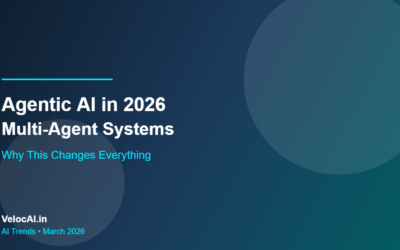
Remember when ChatGPT launched in late 2022 and changed everything overnight? Something equally significant is happening right now, but it’s moving slower and getting less attention. Agentic AI — AI systems that can plan, execute, and iterate on complex tasks independently — is going from research papers to real products. And I think it’s going to reshape how we work more than chatbots ever did.
What Makes Agentic AI Different From Regular Chatbots?
When you use ChatGPT or Claude in a normal conversation, you’re doing a back-and-forth. You ask, it answers, you refine, it adjusts. It’s reactive. You’re driving the car, and the AI is the GPS.
Agentic AI flips that dynamic. You give it a goal — “research these 10 companies and build a comparison spreadsheet” or “find the bug in my codebase and fix it” — and it figures out the steps on its own. It decides what information it needs, which tools to use, what order to do things in, and how to handle problems along the way.
The key difference is autonomy. A chatbot answers questions. An agent completes missions.
Where Are We Actually Seeing This Work?
Multi-agent dashboards are becoming real products in 2026. Imagine a control panel where you kick off tasks from one place and have different AI agents working across your browser, code editor, email, and project management tools simultaneously. That’s not science fiction — companies like Anthropic, OpenAI, and Google are all shipping versions of this right now.
Claude Code’s Agent Teams feature is one of the most concrete examples. You can spin up multiple agents that work on different parts of a codebase in parallel. One agent refactors the authentication module while another writes tests for the API layer. They coordinate without stepping on each other’s work.
In customer service, agentic AI is handling entire support tickets from start to finish — reading the customer’s issue, checking account data, trying solutions, and following up. Not just answering questions, but actually resolving problems.
The “Super Agent” Concept
Industry analysts are calling 2026 the year of “super agents.” The idea is simple but powerful: instead of one AI model doing everything, you have specialized agents connected together. One agent handles data analysis, another handles writing, a third handles research, and an orchestrator coordinates them all.
Think of it like a well-run team. You wouldn’t ask your accountant to design your website. Similarly, a coding agent doesn’t need to be great at writing marketing copy — it just needs to communicate effectively with the agent that does.
This modular approach solves one of the biggest problems with single-model AI: the jack-of-all-trades, master-of-none syndrome. By specializing each agent and letting them collaborate, you get better results on every individual task.
Smaller Models Are Powering the Agent Revolution
Here’s something counterintuitive: the agentic AI revolution isn’t being driven by the biggest models. It’s being driven by smaller, faster, cheaper ones. When you need an agent to make 50 decisions per minute — which tools to call, what data to look up, how to format a response — you can’t afford to wait 10 seconds for each response from a massive model.
The industry has validated that smaller, domain-optimized models are central to making agents work. Techniques like distillation, quantization, and memory-efficient runtimes are pushing AI inference to edge devices and embedded systems. Your AI agent doesn’t always need the smartest model. It needs the fastest one that’s smart enough for that specific task.
NVIDIA’s Nemotron 3 Super is a perfect example — 120 billion parameters total, but only 12 billion active at any time. It’s designed specifically for multi-agent applications where speed and efficiency matter as much as raw capability.
Robotics and Physical AI: Agents in the Real World
The agent concept doesn’t stop at software. 2026 is seeing a genuine acceleration in robotics and physical AI. The models that power digital agents are being adapted to control robots, drones, and autonomous systems in the physical world.
What’s new this year is that robots are learning the way humans do — by trying, failing, and adjusting in real time. Instead of programming every possible scenario, AI-powered robots can adapt to unexpected situations on the fly. A warehouse robot encounters a package in an unusual position? It figures out how to grab it rather than stopping and waiting for a human to intervene.
Manufacturing, logistics, and defense are the early adopters, but the technology is spreading fast. Expect to see agentic AI in agriculture, construction, and healthcare robotics within the next 18 months.
The Challenges Nobody Wants to Talk About
I’d be lying if I said agentic AI is ready for prime time across the board. It’s not. There are real challenges that the hype doesn’t cover.
Error compounding is the biggest one. When an agent makes 20 sequential decisions, even a 95% accuracy rate on each decision means you only get the right final result about 36% of the time. That’s why current agents work best on tasks where each step can be verified independently.
Trust is another issue. How do you audit what an AI agent did? If it made 50 API calls and 30 data lookups to reach a conclusion, tracing its reasoning is hard. Enterprises need explainability before they’ll hand over critical business processes to autonomous agents.
And then there’s the cost question. Running multiple agents on complex tasks burns through API credits fast. The economics need to improve before agentic AI becomes viable for smaller businesses.
What Should You Be Doing About This?
If you’re a developer, start experimenting with agent frameworks now. Understanding how to build, deploy, and monitor AI agents is going to be one of the most valuable skills in tech for the next five years.
If you’re a business leader, identify the workflows in your organization that involve multiple steps, multiple tools, and lots of coordination. Those are your best candidates for agentic AI — not because the technology is perfect today, but because starting now gives you a head start on the learning curve.
And if you’re just interested in where technology is heading? Pay attention to this space. Chatbots were the appetizer. Agents are the main course. And the meal is just getting started.